What makes this scene tense?
Scream (1997)
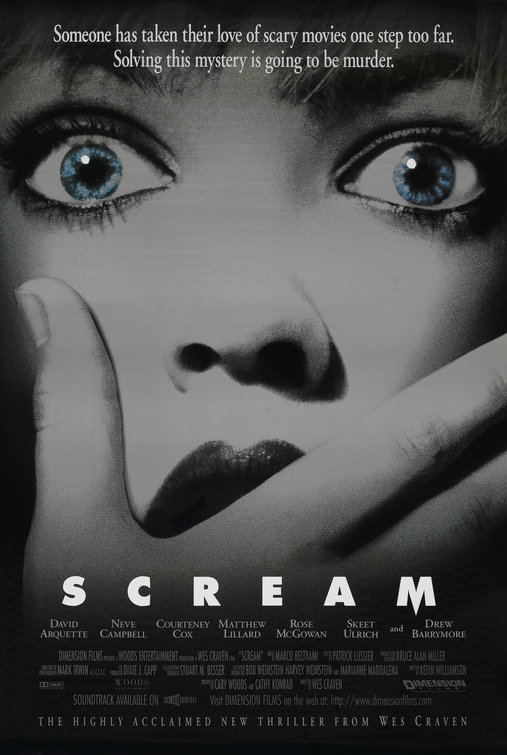
Tension is a key emotion both in the plot of horror/thriller films and to invoke in its audience. It is often a necessity in order for this genre of film to be effective and successful. Therefore, my group and I consider 'tension' to be a vital element included in our main task production since our opening title sequence will be filmed in the genre of a psychological thriller.
To help understand how certain features in a film opening title sequence are used to create tension, I analysed the opening to (1997) 'Scream'.
Enigma codes:
From the opening sequence there are many enigma codes such as;
- Who is the killer?
- What is going to happen to the female?
- Why did she claim that she didn't have a boyfriend when she did?
- Why does she continuously keep picking up the phone?
- Why didn't she just cal, the police
 Titles:
The font of title for Scream is in block which suggests its significance in the movie but otherwise quite plain. However, the transition from white to red indicates there will be blood-shed and violence. The black background symbolising death, fear and the unknown.
Sound:
From the very beginning of the movie, sound is present. The movie starts instantly with creepy non-diegetic, asynchronous music in the background as Dimension Films slowly comes out of the darkness. It is followed by a rumble, as if several doors are being shut - we are instantly made aware that the genre is horror. While the eerie music is still going, the title of the movie is stretched out and comes back together with a loud crash. This is followed by a phone ringing, a heart beating rapidly, a terrifying scream, the foley noise of knife slicing into something, and finally followed by more screams. The ringing phone ties it into the first scene. The caller picks up the phone and the music, the beating heart, and the screams vanish. This is all done within twenty seconds of the film. The fast-paced beginning (much like the rapid heartbeat of a person in fear) makes viewers feel uneasy straight away among the confusion of the many layered and alarming sounds.
As soon as the film starts, there is the diegetic sound of a telephone ringing and the conversation we can hear all the way through. Being able to hear the conversation creates awareness for viewers and enigma codes generate. As the opening sequence gets tenser, non-diegetic sounds start (music that we can hear to create tension but the character cannot). Having the slow music shows that the character is in shock and creates dramatic tension. There is also diegetic sound of a dog barking - this gives indication that something has alerted the dog and is outside.
Another example of sound is in the beginning, when Drew Barrymore's character hangs up the phone for a second time from the mysterious caller. The scene changes to the outside of the house where the camera is focused on some tree branches. There's the sound of some crickets, frogs, etc. In those noises, a creaking sound is heard. The camera travels downward and the viewer sees that it's a swing swaying back and forth that's making the noise. The rope is rubbing against the branch. It creates a feeling of tension because amongst these peaceful night noises is this odd creaking noise. It also leaves the viewer wondering perhaps, is there someone in the tree? Wes Craven is setting these small elements up to scare the viewer.
Yet another example of sound being used, is when Drew Barrymore (Casey) is talking to the mysterious caller. The caller had already changed from a flirtatious and calm tone to a bipolar angry and violent tone where he threatened her. She tells him that her boyfriend is coming over and will essentially beat him up. The caller responds with, "His name wouldn't be Steve, would it?" Casey stands stunned as a loud boom follows. The fear of an unknown antagonist that already knows personal information about his victim, emphasises the feeling of helplessness and the viewer worries for the protagonist's safety. The viewer realises that this call is not just a silly prank.
Wes Craven is adding layers - each passing moment more tense than the last. He's scaring the viewer little by little. Then, when Casey is being chased by the killer, she goes outside and all the viewer can hear is her breathing. Her breathing is rapid, full of gasps and sobs. This again creates tension as you are able to sense her exposure to the antagonist and can hear the fear in her voice.
Mise en Scene:
Craven has already played on the viewer's senses. There's the apprehension that something bad is going to happen. The opening sequence is based in a huge house in the middle of nowhere (we are seeing horror conventions from the beginning). It is also set in the night time (making everything seem more scary from not being able to see what's lurking outside). This generates the enigma code that something is obviously going to happen in such a location where an innocent and typically vulnerable young, blonde-haired girl is in isolation.

Lighting is very low-key - we can hardly see anything outside, it is foggy where the swimming pool is which gives it an eerie effect. The darkness and bad weather give off an uncertainty of what may happen. As there is a solitary, big house with many windows and doors - viewers can assume help won't be able to get there quickly but also that criminals won't find it hard to get in - we sense her vulnerability as the scene progresses.
 The way props are placed and used carefully within the frame affects how the viewer responds to the scene. In the beginning of the movie when the viewer is with Casey, there's a good use of the frame. Casey plays with a knife as she speaks on the phone.. it could foreshadow that this will become an important object in what happens next.
 Camerawork:
There are lots of eye line matches to show what exactly the female character is looking at which create suspense. The camera also does a lot of slow zooms in and outs which builds up tension for the audience, it also allows them time to visualise what is happening. Throughout the opening sequence the camera focus on Casey most of the time, this creates more impact when something does actually happen to her.
Target audience:
Scream is a slasher horror movie, I would assume that it is targeted at late teens to people in their mid-twenties due to the unrealistic and gory plot lines, especially since it is already age rated 18 and includes scenes of violence, profanity, sex and mature themes. The film is also based around a teenagers experience, therefore, a younger audience would be able to find more in common with the protagonist and many of the other character.
Conclusion:
These are just a few elements Wes Craven uses to scare the viewer. He appears to like playing with people's emotions, making them question everyone's motive. He never gives the viewer more than a few minutes to relax and always has them wondering what's going to happen next. It is made evident that adding more elements of tension opens more possibilities to be frightened.

No comments:
Post a Comment